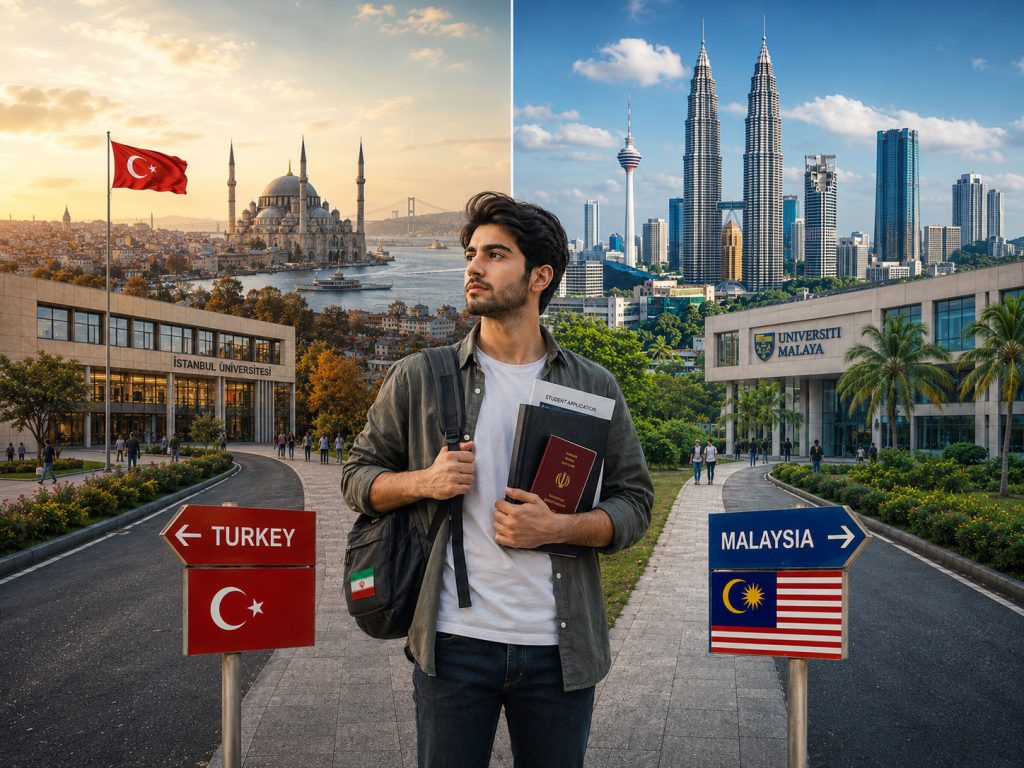
When Iranian students decide to study abroad, they often look for destinations that offer high-quality education, affordable living costs, and straightforward visa processes. For years, two countries have consistently topped the list: Turkey and Malaysia.
Both countries are culturally welcoming to Iranians, offer excellent English-medium programs, and serve as stepping stones to Europe or North America. However, their education systems, lifestyle costs, and post-graduation opportunities are distinctly different.
If you are struggling to decide between the two, this 2026 guide breaks down the study in Turkey vs Malaysia debate across five critical categories to help you make the best choice for your academic and career goals.
Quick Summary
Turkey is the better choice if you want to study medicine or dentistry, prefer a Mediterranean lifestyle close to Iran, and want the option to work part-time during your studies. Malaysia is ideal if you are focused on engineering or IT, want a 100% English-speaking environment, and prefer a tropical, highly diverse international campus experience.
To understand the full scope of what Turkey offers, start by reading our Study in Turkey for Iranian Students: Complete Guide (2026).
1. Academic Quality and University Rankings
Both countries boast universities ranked in the top 500 globally, but their strengths lie in different fields.
Malaysia: The Engineering and IT Hub
Malaysia has heavily invested in becoming a global education hub. Public universities like Universiti Malaya (UM) (ranked #58 globally in 2026) and Universiti Kebangsaan Malaysia (UKM) are highly respected worldwide . Malaysia is particularly strong in Engineering, Computer Science, and Business. Furthermore, Malaysia hosts “branch campuses” of top UK and Australian universities (e.g., University of Nottingham, Monash University), allowing you to earn a Western degree at an Asian price point.
Turkey: The Medical and Architectural Powerhouse
Turkey shines in healthcare, architecture, and social sciences. Universities like Koç University, Sabancı University, and Middle East Technical University (METU) offer world-class facilities. For Iranian students, Turkey’s biggest academic advantage is its medical schools. Turkish medical degrees are highly respected and aligned with the European Bologna Process.
If you are planning to study healthcare, you must read our guide on Turkish Medical Universities Approved by Iran Ministry of Health (2026), as Malaysia’s medical programs are less frequently recognized by Iranian ministries.
2. Tuition Fees and Cost of Living
Cost is often the deciding factor for international students. Both countries are affordable compared to the West, but their cost structures differ.
Tuition Fees
- Malaysia: Public university tuition ranges from $2,500 to $5,000 per year. Private universities and international branch campuses cost between $6,000 and $12,000 annually .
- Turkey: Public universities in Turkey are incredibly cheap, ranging from $500 to $2,000 per year, but admission requires the difficult YÖS exam. Private Turkish universities charge between $3,000 and $10,000 for engineering and business, but medical programs can cost $15,000 to $30,000 per year .
If you want to avoid the YÖS exam, learn How to Apply to Turkish Universities Without YÖS for Iranian Students.
Cost of Living
In 2026, the cost of living in both countries is remarkably similar, though inflation in Turkey causes more frequent price fluctuations.
- Malaysia: A student needs about $400 to $600 per month to cover rent, food, and transport in Kuala Lumpur .
- Turkey: Depending on the city, a student needs $350 to $800 per month. Istanbul is the most expensive, while Ankara is much cheaper. For a detailed breakdown, see our Cost of Living in Turkey for Iranian Students (2026 Update).
3. Visa Processes for Iranian Citizens
The visa process is a crucial consideration, as a rejected visa can derail your academic plans.
Entering Malaysia
Iranian citizens enjoy a 14-day visa-free entry to Malaysia for tourism . However, to study, you must apply for an EMGS (Education Malaysia Global Services) Student Pass before you travel. The process is entirely online but can take 4 to 8 weeks. Once approved, you receive a Visa Approval Letter (VAL) to enter the country and finalize your student pass .
Entering Turkey
Turkey offers a much more relaxed entry process. Iranian citizens have a 90-day visa exemption . You can fly to Turkey without any prior visa, finalize your university registration in person, and then apply for your Student Residence Permit (İkamet) from within the country.
This flexibility is a massive advantage for students who make late decisions. For a step-by-step walkthrough, read The Complete Turkey Student Visa Guide for Iranian Citizens.
4. Language and Cultural Fit
The Language Barrier
- Malaysia: English is the unofficial second language of Malaysia. All university courses are taught in English, and you can easily navigate daily life, shopping, and government offices using only English.
- Turkey: While top universities teach in English, the general public speaks Turkish. To live comfortably, negotiate rent, or make local friends, you will need to learn conversational Turkish.
Cultural Environment
Both countries are Muslim-majority, meaning halal food is everywhere and Islamic holidays are observed, which provides a comfortable environment for Iranian families.
- Turkey offers a Mediterranean, Eurasian lifestyle with four distinct seasons. It is geographically very close to Iran, making flights home cheap and quick (about 3 hours to Tehran).
- Malaysia offers a tropical, multicultural Southeast Asian experience. It is a melting pot of Malay, Chinese, and Indian cultures. However, it is a 9-hour flight from Tehran, making frequent visits home more difficult and expensive.
5. Part-Time Work and Post-Graduation Opportunities
What happens during and after your studies?
Working While Studying
- Turkey: International undergraduate students are legally allowed to work part-time (up to 24 hours a week) after completing their first year of study .
- Malaysia: International students are permitted to work part-time (up to 20 hours a week), but only during semester breaks or holidays of more than seven days. Working during active semester weeks is strictly prohibited.
Post-Graduation Visas
- Malaysia: Malaysia recently introduced a “Graduate Pass” that allows international students to stay in the country for up to one year after graduation to travel or seek employment . If you find a job, your employer must sponsor an Employment Pass.
- Turkey: Turkey does not offer a dedicated post-study job-seeker visa. You must leave the country within 10 days of your student residence permit expiring unless you have already secured a job and your employer has applied for a Work Permit on your behalf . However, many Iranian students use Turkey as a stepping stone to apply for Master’s programs or jobs in Germany, the UK, or Canada.
The Final Verdict: Which Should You Choose?
Choose Turkey if:
- You want to study Medicine, Dentistry, or Pharmacy.
- You want to be close to Iran for easy travel.
- You prefer a Mediterranean climate over tropical humidity.
- You want the option to work part-time during the semester.
- You plan to eventually practice in Iran (ensure you check the Turkish Universities Approved by Iran Ministry of Science).
Choose Malaysia if:
- You want to study Computer Engineering, IT, or Business.
- You want a 100% English-speaking environment inside and outside the university.
- You are interested in getting a UK or Australian degree from a branch campus.
- You want a guaranteed one-year post-graduation visa to look for work.