
If you are comparing these two majors, you are probably trying to answer a very practical question. Do you want to study people in a broad way, or do you want to focus more specifically on children and how they grow, learn, and develop?
This is why students often hesitate between Psychology and Child Development. The two majors overlap. Both explore behavior, development, learning, and human relationships. Both can lead to work in education, support services, research, and postgraduate study. But they are not the same major, and they do not usually train you in the same way.
The difference between psychology and child development is mainly about scope. Psychology is a broader field that studies behavior, cognition, emotion, and mental processes across different age groups and settings. Child Development is more focused on children, usually from infancy through adolescence, and on the contexts that shape their development, such as family, culture, peers, school, and community.
In simple words, Psychology asks, How do people think, feel, behave, and develop? Child Development asks, How do children grow and change, and what affects that growth in real life?
That difference affects what you study, how broad the degree feels, what kind of internships make sense, and what jobs may feel more natural after graduation.
A useful way to think about it is this: Psychology is usually broader and more theory- and research-oriented, while Child Development is usually narrower in age focus and more directly connected to children, families, schools, and developmental settings.
If you want a major that gives you broad knowledge of human behavior and can later connect to many different sub-fields, Psychology may fit better. If you already know that you want to work more directly with children, families, learning environments, or child-centered services, Child Development may be the better choice.
Quick Comparison Table, Psychology vs Child Development
| Area | Psychology | Child Development |
|---|---|---|
| Core focus | Human behavior, mental processes, emotion, cognition, and social interaction | How children grow and develop from infancy through adolescence |
| Main age focus | All ages, depending on specialization | Mostly children and adolescents |
| Main level of analysis | Individual behavior, mental processes, social interaction, research | Child growth within family, school, peer, and community contexts |
| Typical subjects | General psychology, developmental psychology, cognitive psychology, research methods, statistics, social psychology | Child development, infancy, adolescence, cognitive development, social development, family and school context, research methods |
| Learning style | Broad, research-oriented, theory-based, often analytical | Development-focused, context-based, often more applied to children and families |
| Math and statistics | Usually moderate to strong, especially with research methods and statistics | Usually moderate, depending on program design |
| Best fit for you if… | You want a broad understanding of behavior and may explore different populations or later specializations | You want to focus early on children, families, education, or developmental support |
| Common career direction | Research support, behavioral support, human services, graduate study, psychology-related pathways | Early childhood settings, child support services, family programs, education-related roles, child advocacy |
| Graduate study path | Psychology, counseling, clinical fields, education, HR, research, health-related programs | Child development, education, special education, family studies, social work, psychology, child-focused graduate fields |
What Is Psychology?
The U.S. Bureau of Labor Statistics explains that psychologists study cognitive, emotional, and social processes and behavior by observing, interpreting, and recording how people relate to one another and to their environments. Even though that definition comes from the profession side, it captures the academic core of psychology very well.
A Psychology major is usually built around understanding how people think, feel, behave, learn, remember, interact, and change. It is a broad discipline. You may study topics such as cognition, development, personality, abnormal psychology, social behavior, research design, and statistics.
That broadness is one of psychology’s biggest strengths. A student may begin the degree interested in mental health, then later become more interested in child development, workplace behavior, research, education, neuroscience, or community support. The major gives room to explore.
At the same time, that breadth can make the degree feel less directly career-specific at bachelor level. Psychology gives a strong foundation, but many licensed or independent psychology careers usually require advanced study beyond the bachelor’s degree.
What Is Child Development?
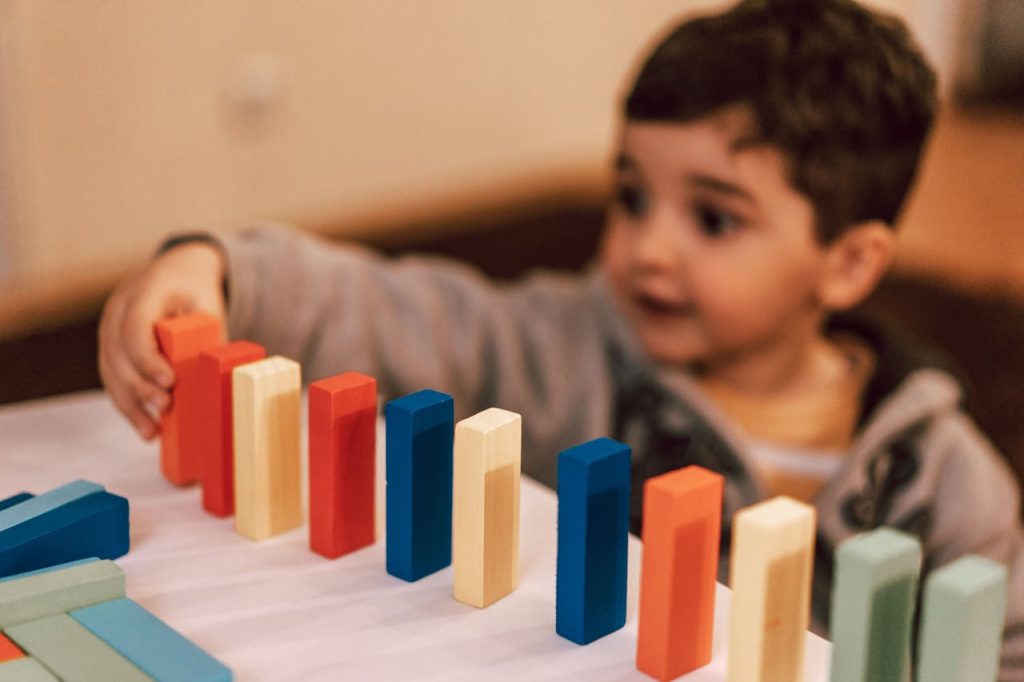
Vanderbilt University describes Child Development as a field for students who want to study children from infancy through adolescence and the major contexts in which they live, including family, culture, peers, school, and neighborhood. Vanderbilt also explains that the field focuses on the scientific study of the biological, cognitive, and social development of young humans.
This definition shows why Child Development is not simply “Psychology for children.” It is more focused in age range and often more connected to real developmental environments. A child development student is not only asking how a child thinks or feels. They are also looking at how family structure, school setting, peer relationships, and social conditions shape development.
A Child Development degree often feels more targeted from the beginning. Students usually know they are interested in children, child learning, developmental support, family work, education-related settings, or community roles connected to young people.
For some students, that clarity is a major advantage. Instead of studying people across the whole lifespan, they spend more time learning about the specific stages, contexts, and challenges of childhood and adolescence.
The Main Difference Between Psychology and Child Development
The main difference is broad human behavior across populations versus focused child growth within developmental contexts.
Broad human behavior vs child-centered development
Psychology usually studies behavior and mental processes more broadly. Depending on the program, you may look at children, adults, groups, personality, cognition, emotion, social interaction, and research across many parts of human life.
Child Development usually narrows that lens. The central question is how children develop physically, cognitively, emotionally, and socially, and how the environments around them affect that development.
So if you imagine yourself asking, “How do people think, behave, and respond across different situations?” Psychology may fit better. If you imagine yourself asking, “How do children grow, learn, adapt, and develop in family and school settings?” Child Development may be the stronger match.
Theory and research breadth vs age-specific applied focus
Psychology programs often feel broader and more theory-based. You may study many concepts before deciding where you want depth. One semester may focus on cognition, another on personality, another on development, and another on research design.
Child Development is often more age-specific and context-specific from the start. The curriculum usually stays closer to infancy, childhood, adolescence, family influence, education, developmental milestones, and child-centered support systems.
That does not mean Child Development is less scientific. It simply means the science is concentrated around children and their environments rather than spread across the whole field of psychology.
Flexible later specialization vs earlier directional clarity
Psychology is often attractive to students who want flexibility. You may begin with a general interest in people and later move toward child psychology, counseling, education, research, organizational behavior, or other specializations.
Child Development is often attractive to students who already know they want a child-focused path. It can give earlier clarity and a more direct academic identity, especially for students interested in education-related work, family programs, developmental support, or child advocacy.
A simple real-life example helps here. One student says, “I want to understand people deeply, and I am still open to many future paths.” That student often fits Psychology. Another student says, “I know I want to work around children, families, learning, and developmental growth.” That student often fits Child Development.
What Will You Study in Each Major?
The best way to compare these majors is to look at curriculum, not just degree title. Universities in Turkey and abroad may use different course names, but the general pattern is usually clear.
Core psychology courses
A Psychology curriculum often includes introductory psychology, developmental psychology, cognitive psychology, social psychology, research methods, and statistics. Depending on the university, students may also study personality, abnormal psychology, learning, neuroscience, or counseling-related foundations.
This means Psychology usually gives you broad conceptual and analytical training. You learn how researchers study behavior, how theories explain mental processes, and how evidence is used to understand people.
If you are the kind of student who says, “I want a major that helps me understand many sides of human behavior before I specialize,” Psychology often gives that kind of foundation.
Core child development courses
Vanderbilt’s program description shows a Child Development curriculum centered on theories, research findings, and research methods related to child development, along with coursework in infancy, adolescence, cognition, and social and personality development.
That kind of curriculum tells you something important. Child Development is not just general care for children. It is an academic field grounded in developmental science. But the science stays close to how children grow, learn, interact, and change over time.
Students in this major often spend more time connecting theory to developmental settings. The questions become very practical. How do children learn? How do family and school affect growth? What developmental changes happen in adolescence? How do social and emotional conditions affect outcomes?
Research methods, statistics, and scientific thinking
This is one of the most important practical differences for international students.
Psychology usually includes a stronger broad-based research identity. Many programs emphasize research methods and statistics because the field depends heavily on evidence, observation, and interpretation.
Child Development also uses research and scientific methods, but often in a more focused developmental context. Vanderbilt explicitly highlights developmental theory, research findings, and research methods central to the field.
In practice, both majors require you to think scientifically. The difference is not that one is scientific and the other is not. The difference is where that science is applied.
Similarities Between Psychology and Child Development
These majors are different, but they are not opposites. That is why students confuse them so often.
Both degrees help you understand how humans grow, behave, and respond to the world around them. Both can connect to education, research, community support, family services, and health-related pathways. Both may include developmental topics, observation, theory, and research methods.
In fact, Child Development can be an excellent preparation for later study in psychology-related or child-focused fields, and Vanderbilt explicitly notes that it can prepare students for future study in psychology, medicine, nursing, education, and public policy.
That overlap is important. If you are undecided, it does not mean you are lost. It means you are choosing between two related pathways that overlap at the foundation level but differ in scope and direction.
Career Paths and Future Options
A major does not decide your future by itself. Internships, country of study, postgraduate education, language ability, and practical experience matter a lot. Still, the career direction of each major tends to feel different.
Psychology careers and graduate pathways
The U.S. Bureau of Labor Statistics says psychologists study cognitive, emotional, and social processes and behavior, and it also notes that psychologists typically need an advanced degree and that licensing requirements vary by role and location.
This is a very important point for students and parents. A bachelor’s degree in Psychology can be useful and respected, but many clinical and licensed psychologist roles are not direct entry-level outcomes after graduation.
At bachelor level, psychology graduates often move into roles connected to behavioral support, research assistance, education support, community services, human resources, case coordination, or related people-focused environments. The major is strong, but it often works best when students understand early that some career goals will require further study.
Child development careers and child-centered work settings
The U.S. Bureau of Labor Statistics explains that preschool teachers educate and care for children younger than age 5 who have not yet entered kindergarten. BLS also notes that entry requirements vary by setting and regulation.
This does not mean every Child Development graduate becomes a preschool teacher. It means child-centered fields often connect more directly to developmental and educational settings at the undergraduate level.
Child Development graduates may be drawn to early childhood environments, family and child service programs, child advocacy settings, educational support, community programs, and development-focused organizations. Vanderbilt also highlights career directions such as child advocacy, service provision, education, nonprofit work, and research.
So if a student says, “I want to work more directly with children and families soon after graduation,” Child Development often gives a more immediate thematic match.
Graduate study considerations
Psychology is often the stronger choice if you want maximum flexibility for later specialization across multiple psychology-related areas. Child Development is often the stronger choice if you already know that your long-term interests are centered on children, families, and developmental systems.
Neither major closes doors by itself. But the shape of your future options may feel different. Psychology gives broader behavioral breadth. Child Development gives more focused child-centered depth.
Which Major Should You Choose?
The better major is the one that matches your interests, strengths, and the kind of people or problems you want to work with.
Choose psychology if you want broader flexibility
Psychology may be the better choice if you want a broad understanding of human behavior and are not fully sure yet whether your future lies in child-focused work, mental health, research, education, organizational settings, or another direction.
This major often suits students who enjoy theory, research, analysis, and the idea of keeping multiple future options open.
It can also be a smart choice if you think you may later pursue graduate study in psychology, counseling, behavioral science, or another related field.
Choose child development if you already know you want a child-focused path
Child Development may be the better choice if you are already drawn to infancy, childhood, adolescence, family systems, learning environments, or child-centered service settings.
This major often suits students who want their studies to stay close to children’s development from the beginning, rather than exploring human behavior across a much wider range.
If you can picture yourself working in schools, developmental support settings, family programs, child advocacy, or early learning environments, Child Development may feel more natural and more motivating.
Studying Psychology and Child Development in Turkey and Abroad
For international students, this decision becomes even more important when comparing universities across countries.
In Turkey and abroad, Psychology programs can vary a lot in emphasis. Some are more research-oriented. Some are more clinically oriented in identity, even though clinical practice usually requires further qualifications. Some programs offer strong electives in child and adolescent development. Others lean more toward general theory and research.
Child Development programs also vary. Some are strongly linked to education and developmental support. Others are more interdisciplinary, connecting psychology, family studies, and social development.
That is why you should compare more than the department name. Look at the course structure, internship opportunities, practical training, research components, language of instruction, and whether the degree leads naturally toward the career path you want.
Ask practical questions such as these:
| Question to ask | Why it matters |
|---|---|
| Does the Psychology program include strong child-development electives? | Helpful if you want both breadth and child-related focus. |
| Is the Child Development degree more academic, educational, or applied? | This changes the student experience significantly. |
| Are internships or field placements included? | Important for practical readiness and employability. |
| What is the language of instruction? | This affects learning comfort and future mobility. |
| Does your target career require graduate study or licensing? | Essential for realistic long-term planning. |
| Does the university offer strong support in research or community work? | Helpful if you want either academic depth or applied developmental experience. |
Common Mistakes Students and Parents Make
One common mistake is assuming Child Development is just a smaller version of Psychology. It is not. Child Development has its own academic focus, methods, and practical direction centered on children and developmental contexts.
Another mistake is assuming a Psychology degree automatically leads to becoming a psychologist. In reality, the U.S. Bureau of Labor Statistics makes clear that psychologists typically need advanced degrees and that licensing requirements vary.
A third mistake is choosing Psychology only because it sounds broader or more prestigious, without asking whether the student actually wants to work with children, families, schools, or developmental settings in a more direct way.
A fourth mistake is choosing Child Development without checking how the degree is structured in a specific country or university. Some programs are highly applied. Others are more theoretical. Some connect strongly to education. Others connect more to social services or developmental research.
The best decision usually comes from honest self-assessment. Do you want to understand human behavior broadly, or do you already know that your main interest is children and their development?
FAQ
Which major is broader, psychology or child development?
Psychology is usually broader. It studies behavior and mental processes across different populations and contexts, while Child Development focuses more specifically on children and the environments that shape their growth.
Which major is better if I want to work with children?
Child Development is often the more direct fit if you already know you want to work with children, families, schools, or developmental settings. Psychology can also lead there, especially with later specialization, but it usually starts as a broader field.
Can I become a psychologist with a bachelor’s degree in psychology?
In many cases, no. The U.S. Bureau of Labor Statistics states that psychologists typically need an advanced degree and that licensing requirements vary by role and place.
Is child development easier than psychology?
Not necessarily. They are different, not simply easier or harder. Psychology may feel broader and more research-heavy. Child Development may feel narrower in age focus but still requires strong understanding of theory, development, and context.
Which major is better for studying in Turkey?
That depends on the university, curriculum, teaching language, internship model, and your long-term career plan. In Turkey, the smartest approach is to compare actual course structures and career outcomes, not just the degree title.
References
[1] Psychologists, U.S. Bureau of Labor Statistics
[2] Child Development, Vanderbilt University Undergraduate Admissions
[3] Preschool Teachers, U.S. Bureau of Labor Statistics
[4] Study Psychology, StudySehir
[5] Family and Human Development vs. Psychology, NMSU Global Campus